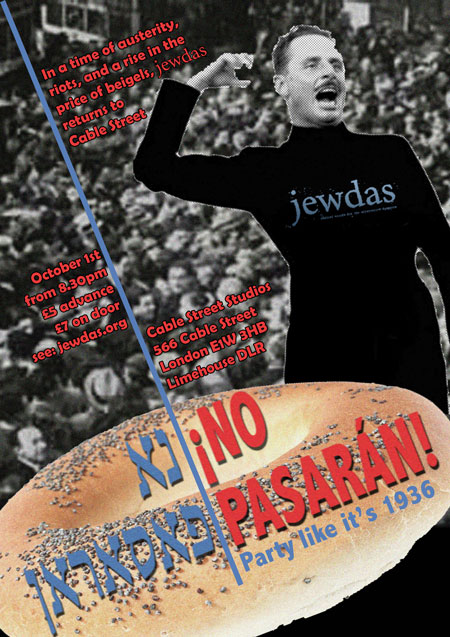
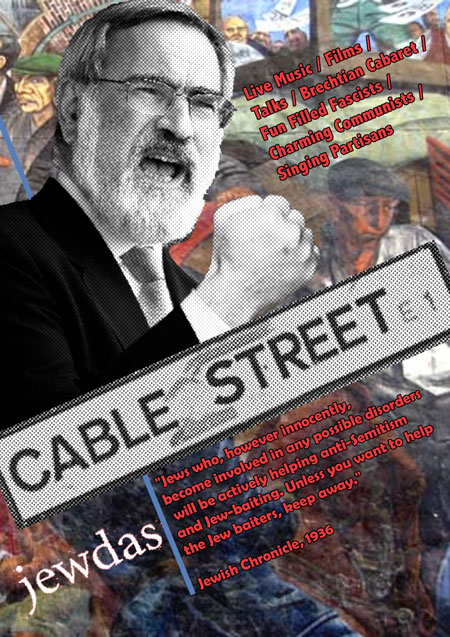
Anyway here's google cache to the rescue:
Ian Bone
By the time letters protesting the Council's decision were being published in the IT the same paper was reporting that the UK Education Minister and "proud Zionist", Michael Gove, had lobbied against schools participating in the event.A ROW has erupted between Islington North Labour MP Jeremy Corbyn and a senior Town Hall official over advice warning primary schools against taking part in a Palestinian literature festival.Former children’s laureate Michael Rosen is among those taking part in the event, organised by Haringey Justice for Palestine group, which runs from September 29 to October 2.Mr Rosen is also angry about the advice that schools should not become involved. He said: “It’s very disappointing and a rather strange way to behave by Islington Council. Instead of entering into a conversation with the organisers they have simply taken the word of someone and then taken this somewhat draconian step to advise people not to take part.”The advice came from the Labour-controlled council’s corporate director of children’s services, Eleanor Schooling, who warned that the “political” nature of the event might contravene the 1996 Education Act.Two schools, including Duncombe Primary in Upper Holloway, were due to take part in the Tottenham Palestinian Literature Festival. Both have since reluctantly withdrawn from the event.However, it appears that Ms Schooling had been advised by the Board of Deputies of British Jews, who had expressed concerns.
Good letter! A report, a complaint and a call to action.
IT was rather misleading for the Board of Deputies of British Jews to claim it represents all British Jews.I and other Jews living in Islington would have nothing to do with this partisan, sectarian and Israeli-apologist body.Having left Israel because of the apartheid against Palestinians, it is important for me to work with those objecting to racism of all forms.One such group is the No to Veolia Action Group and if you are appalled by the Israeli illegal settlements then you can join us at 7.30pm on Monday, October 24, at the Regent pub in Liverpool Road.YAEL KAHN
N1
I must say that David Rosenberg deserves special credit for wading through a mountain of Jewish Chronicles from the time when they were advising Jews to not be so Jewish and to stay at home and ignore those nasty fascists.
Battle for the East End: Jewish responses to fascism in the 1930s
268pp ISBN: 978 1907869181 Five Leaves Publications, 2011, £9.99
What’s the book about?
During the 1930s, Oswald Mosley’s Blackshirts intensified their campaign against the Jewish community, particularly in London’s East End. As that campaign became more overtly antisemitic, and more physically intimidating, Jewish groups debated how to deal with the Fascist threat, ultimately building their own defence organisations, and forging alliances with other campaigners. The simmering tensions in East London culminated in the Battle of Cable Street, when more than 100,000 people, especially from the local Jewish and Irish communities, prevented Mosley’s troops from marching through the East End.
In Battle for the East End, David Rosenberg charts the changing nature of the British Union of Fascists’ ideas about Jews and describes the growing rifts between the official leaders of the Jewish community and those who wanted to mount an active resistance to the fascists.
“Battle for the East End is written by an anti-fascist activist with a real feel and connection both to the politics and the geographical area he writes about. For anyone who wants to understand the political, historical and cultural context in which the Battle of Cable Street took place then Battle for the East End is a must for the bookshelf.” Searchlight Educational Trust“The Battle of Cable Street is one of the most celebrated moments in Anglo-Jewish history and, in Battle for the East End, David Rosenberg gives a compelling account of the context and controversies that surrounded it, made even more vivid by eye-witness testimony.” Nadia Valman, Jewish ChronicleContents of the book
Preface
Introduction
1. Britain’s Jews
2. How Jews were viewed
3. The rise of Mosley’s movement
4. Antisemitism and the British Union of Fascists
5. How Jewish leaders perceived the threat
6. Battle for the East End
7. Divided on defence: the grassroots rebellion
8. Rally to Aldgate and Cable Street
9. Antisemitism, fascism and the state
Conclusion
Order it online
To purchase the book online go to:http://inpressbooks.co.uk/battle_for_the_east_end_jewish_responses_to_fascism_in_the_1930s_david_rosenberg_i022676.aspx
Battle for the East End is one of five publications that Five Leaves are publishing to coincide with the 75th anniversary of the Battle of Cable Street. To see the other titles visit: http://www.fiveleaves.co.uk/
Come to a reading/discussion from David’s book
Wednesday 12th October, 7.30pm Reading/discussion at England’s Lane Bookshop, NW3 4YD
Thursday 13th October, 5.30pm, illustrated talk on Cable Street with book excerpts, in Small Hall Cinema, Goldsmiths College, SE14 6NW
Thursday 20th October 6.30pm Brick Lane bookshop, 166 Brick Lane E1 reading/discussion (jointly with Roger Mills)
Saturday 22nd October, 11am, illustrated talk on Cable Street with book excerpts, at the Anarchist Bookfair (room 319), Queen Mary College, E1
On Thursday Palestinians are protesting about the latest instance of ethnic cleansing by the Israeli government. In the Beer Sheba (Beer es Saba) region of southern Israel about 30,000 inhabitants are about to be driven from their homes.Their villages have been designated "unrecognised" for more than 60 years, making their lands easy prey for confiscation. And while they are refused the same rights as other Israeli citizens to facilities such as running water, schools and hospitals, the Israeli state demands their taxes.The British government must condemn any move to evict the Palestinian citizens of Israel from their lands, which were documented under the British Mandate as privately owned Palestinian land – not ownerless as the Israeli state now claims.
Geoffrey Bindman QC
Victoria Brittain
William Dalrymple
Ken Loach
Tony Benn
Ahdaf Soueif
Miriam Margolyes
Caryl Churchill
Jeremy Corbyn MP
Linda Riordan MP
Bob Russell MP
Martin Caton MP
Katy Clark MP
Alex Cunningham MP
Julie Hilling MP
John McDonnell MP
Andy Slaughter MP
Dame Jenny Tonge
John Pilger
Leila Sansour
Ghada Karmi
Ilan Pappe
Dr Salman Abu Sitta
Prof Steven Rose
Prof Hilary Rose
Louise Christian
Rodney Bickerstaffe
Bruce Kent
Reem Kelani
Lowkey
Kika Markham
Michael Rosen
Leon Rosselson
Alexei Sayle
Jeremy Hardy
Hugh Lanning, Chair PSC
Keith Sonnet
John Austin
Canon Garth Hewitt
Andy de la Tour
• Those who lead European football must respond to an appeal from Palestinians dismayed at the prospect of Israel hosting Uefa's under-21 tournament in 2013. A state that uses military might to hold sway over land it illegally occupies and exploits, flouts international law and ignores UN resolutions surely forfeits the right to be treated as a member of the community of nations. But western powers continue to embrace Israel as an ally.During the 2011 under-21 tournament in Denmark in June, 42 Gazan football clubs, backed by many sporting bodies, wrote to Uefa president Michel Platini calling on his organisation not "to reward Israel for its violent repression of Palestinian rights". We ask Uefa to respond positively to this plea.Stephane Hessel diplomat
Ken Loach filmmaker
Michael Mansfield barrister
Miriam Margolyes actor
Nurit Peled Sakharov Prize for Freedom of Thought joint winner 2001
John Pilger journalist and filmmaker,
Ahdaf Soueif novelist and political and cultural commentator
Jean Ziegler vice-president, advisory committee of the UN human rights council
• The government changes the law and brings out the red carpet to allow alleged Israeli war criminals into the UK (Former Israeli minister to visit UK after change in arrest law, 4 October) but changes the rules to arrest visiting Palestinians whose only "crime" is to campaign for their rights (Palestinian activist was held unlawfully, says high court, 1 October). The Goldstone report, which has been endorsed at the UN general assembly, provides clear evidence of how in its 2008-09 attack on Gaza, Israel was responsible for attacks on children, use of human shields, and use of phosphorous bombs and flachettes in civilian areas. Amnesty International and Human Rights Watch have also documented serious cases of abuse. For William Hague to invite to the UK Israeli leaders who were in government at the time these alleged crimes were committed is a slap in the face for relatives of the 1,400 dead, the 5,000 injured and the many others who suffered due to Israel's Cast Lead attack on Gaza.
Dr Stephen Leah
York
Israeli liberals are in a celebratory mood for a day. The Supreme Court ordered the Minister of Interior to register an important secular israeli writer as "without religion" instead of "Jew." Itzhak Laor deflates this delusional celebration, pointing out that the state registers religious affiliation as a code, and showing how, underneath the code, the (colonial) definition of an Israeli Jew is "anyone who isn't Palestinian."
A big celebration. Even Yoram Kaniuk, not only his grandson, and not only masses of immigrants from the former Soviet Union, will from now on be defined negatively: "without religion" (afer a court last week sided with the Israeli writer, granting him the right to register his status that way ). That is how the whole is being redefined: We are all Jews by religion, except for Kaniuk, his grandson and the immigrants from the FSU, who acquired Jewish identity from the Jewish Agency envoys and lost it at the Chief Rabbinate, which is the department for identifying Jews.
And still, the festivities surrounding this quasi-constitutional event look somewhat like a high school drinking party: You get drunk after a few gulps, and vomit.
Why list religion at all? Where else is religion listed in the population registry? In which democracy does a person's religion appear on the lists? The secular celebrants are saying with anger full of satisfaction: "only in Iran," since by means of the comparison with Iran we immediately join the West, just as by mocking the ultra-Orthodox one becomes "modern" here; but Israel really isn't a religious state.
The truth is harder to digest. In the first place religion is listed for the purpose of national identification, unconnected to religion. Because the nationality clause created "constitutional problems," the state was afraid to leave its citizens without identifying them. And that's how they gave the Chief Rabbinate the job of being the identifier: Jews, and those who aren't Jews are Muslims, or Christians or Druze.
Not to worry: The Shin Bet security services and the police fill in the blanks, and if there's confusion between a Christian from Kiev who sells good pork in Netanya and a Christian from Yefia who works in the pig sty of one of the kibbutzim in the Jezreel Valley, the concerned citizen needn't worry. Everything is properly registered, without any euphemisms. Not only in the cellars of the Shin Bet and the codes of the police, even the Central Bureau of Statistics, which annually provides the public with demographic data about the number of Arab babies and Jewish babies that were born, has created a category of "Christians who are not Arabs."
That shows you that it's less important to the state if you're a Catholic from Mi'ilia, or a Greek Orthodox Christian from Lod, or a Protestant from Reneh, or a Pravoslav from Ashdod; what's most important is whether we're talking about an Arab, or about someone who can join the ruling majority, in other words the Christian from Kiev, regardless of his language and his culture. A negative definition: He's not an Arab.
The formal religious institutions were invented by Zionism during the period of the state in the making, when it imported Rabbi Kook to compete with Rabbi Sonnenfeld from Mea She'arim. But the rabbinate has no connection to halakha (religious law ) because the Jews never had central institutions for halakha. That's why the rabbinate does not decide on halakha. Since the establishment of the state it has been engaged only in identifying nationality.
Now we should ask those who are celebrating with Kaniuk: Can a Jewish state be "Jewish" - forget its partner, "democratic," for a moment - without the identifying institutions: the rabbinate, the police, the Shin Bet?
Isn't the reason for the tremendous importance of the "religion clause" the anti-democratic need to distinguish between Jews and Arabs, in order to discriminate simply by defining the difference? Of course.
It seems that the vast majority of those celebrating Kaniuk's success are willing to be satisfied with little, a kind of trampling on the hat of the religious. We screwed them again. But the main thing is that we are left with the glory of chauvinism itself: A country that is defined according to the nationality of the majority is informing the minority every morning: We are, and you are not.(Haaretz, October 6)
The former Israeli foreign minister, Tzipi Livni, will meet the foreign secretary, William Hague, in Britain on Thursday in the first test of a new law governing arrest warrants for war crimes.For a commentary on the change of UK law to appease Israeli war criminals see Electronic Intifada.
Manissa McCleave Maharawal writes powerfully about how she was drawn to the occupation of Wall street and her experience with challenging the invisibility of race in the that space. You should go read the whole piece, but here are below a few paragraphs:
...I think this is what Occupy Wall Street is right now: less of a movement and more of a space. It is a space in which people who feel a similar frustration with the world as it is and as it has been, are coming together and thinking about ways to recreate this world. For some people this is the first time they have thought about how the world needs to be recreated. But some of us have been thinking about this for a while now. Does this mean that those of us who have been thinking about it for a while now should discredit this movement? No. It just means that there is a lot of learning going on down there and that there is a lot of teaching to be done.
On Thursday night I showed up at Occupy Wall Street with a bunch of other South Asians coming from a South Asians for Justice meeting. Sonny joked that he should have brought his dhol so we could enter like it was a baarat. When we got there they were passing around and reading a sheet of paper that had the Declaration of the Occupation of Wall Street on it. I had heard the “Declaration of the Occupation” read at the General Assembly the night before but I didn’t realize that it was going to be finalized as THE declaration of the movement right then and there. When I heard it the night before with Sonny we had looked at each other and noted that the line about “being one race, the human race, formally divided by race, class…” was a weird line, one that hit me in the stomach with its naivety and the way it made me feel alienated. But Sonny and I had shrugged it off as the ramblings of one of the many working groups at Occupy Wall Street.
But now we were realizing that this was actually a really important document and that it was going to be sent into the world and read by thousands of people. And that if we let it go into the world written the way it was then it would mean that people like me would shrug this movement off, it would stop people like me and my friends and my community from joining this movement, one that I already felt a part of. So this was urgent. This movement was about to send a document into the world about who and what it was that included a line that erased all power relations and decades of history of oppression. A line that would de-legitimize the movement, this would alienate me and people like me, this would not be able to be something I could get behind. And I was already behind it this movement and somehow I didn’t want to walk away from this. I couldn’t walk away from this.
And that night I was with people who also couldn’t walk away. Our amazing, impromptu, radical South Asian contingency, a contingency which stood out in that crowd for sure, did not back down. We did not back down when we were told the first time that Hena spoke that our concerns could be emailed and didn’t need to be dealt with then, we didn’t back down when we were told that again a second time and we didn’t back down when we were told that to “block” the declaration from going forward was a serious serious thing to do. When we threatened that this might mean leaving the movement, being willing to walk away. I knew it was a serious action to take, we all knew it was a serious action to take, and that is why we did it.
I have never blocked something before actually. And the only reason I was able to do so was because there were 5 of us standing there and because Hena had already put herself out there and started shouting “mic check” until they paid attention. And the only reason that I could in that moment was because I felt so urgently that this was something that needed to be said. There is something intense about speaking in front of hundreds of people, but there is something even more intense about speaking in front of hundreds of people with whom you feel aligned and you are saying something that they do not want to hear. And then it is even more intense when that crowd is repeating everything you say– which is the way the General Assemblies or any announcements at Occupy Wall Street work. But hearing yourself in an echo chamber means that you make sure your words mean something because they are being said back to you as you say them.
Opposition Chairwoman Tzipi Livni announced that she will travel to London next week, her first trip to the United Kingdom since it issued a warrant for her arrest in the aftermath of Operation Cast Lead.The article goes on to list out some of the Israeli war crimes suspects who have had to avoid or flee the UK for fear of arrest.
British Foreign Secretary William Hague called Livni last week, on the eve of Rosh Hashanah, and invited her to visit the UK. On Sunday, she said that she has accepted the invitation.
Related stories:
- UK amends law that allows arrest of Israeli officials
- Peretz evades UK arrest warrant
- Meridor cancels UK visit for fear of arrest
The news came two weeks after British legislators amended the law that allowed arrest warrants to be issued against Israeli officials, making Livni's trip possible.
Palestinian poet Taha Muhammad Ali from Nazareth passed away.
Taha Muhammad Ali is one of the leading poets on the contemporary Palestinian literary scene. Born in 1931 in Galilee village of Saffuriya, he fled to Lebanon, together with most of the inhabitants of his village, during the Arab-Israeli war of 1948. A year later he slipped back across the border with his family and settled in Nazareth, where he has lived ever since. The Saffuriya of his childhood has served as the nexus of his poetry and fiction, which are grounded in everyday experience and driven by a storyteller’s vivid imagination. He is self-taught and began his poetry career late (in 1983). Taha Muhammad Ali writes in a forceful and direct style, with disarming humor and unflinching, at times painful, honest—the poetry’s apparent simplicity and homespun truths concealing the subtle grafting of classical Arabic and colloquial forms of expression. In Israel, in the West Bank and Gaza, and in Europe, audiences have been powerfully moved by Taha Muhammad Ali’s poems of political complexity and humanity. He has published several collections of poetry and is also a short story writer.(Sakakini)
Ambergris
Our traces have all been erased,
our impressions swept away -
and all the remains
have been effaced...
there isn't a single sign
left to guide us
or show us a thing.
The age has grown old,
the days long,
and I, if not for the lock of your hair,
auburn as the nectar of carob,
and soft as the scent of silk
that was here before,
dozing like Arabian jasmine,
shimmering like the gleam of dawn,
pulsing like a star -
I, if not for that lock of camphor,
would feel not a thing
linking me
to this land.This land is a traitor
and can't be trusted.
This land doesn't remember love.
This land is a whore
holding out a hand to the years,
as it manages a ballroom
on the harbor pier -
it laughs in every language
and bit by bit, with its hip,
feeds all who come to it.This land denies,
cheats, and betrays us;
its dust can't bear us
and grumbles about us -
resents and detests us.
Its newcomers,
sailors, and usurpers,
uproot the backyard gardens,
burying the trees.They keep us from looking too long
at the anemone blossom and cyclamen,
and won't allow us to touch the herbs,
the wild artichoke and chicory.Our land makes love to the sailors
and strips naked before the newcomers;
it rests its head along the usurper's thigh,
is disgraced and defiled in its sundry accents;
there seems to be nothing that would bind it to us,
and I - if not for the lock of your hair,
auburn as the nectar of carob,
and soft as the scent of silk,
if not for the camphor,
if not for the musk and the sweet basil,
if not for the ambergris -
I would not know it,
and would not love it,
and would not go near it...Your braid
is the only thing
linking me, like a noose, to this whore.(ofblog)
Empty WordsAh, little notebook,
yellow as a spike of wheat
and still as a face,
I’ve protected you
from dampness and rodents
and entrusted you with
my sadness and fear,
and my dreams—
though in exchange I’ve gotten from you
only disobedience and betrayal…
For otherwise where are the words
that would have me saying:
If only I were a rock on a hill…
unable to see or hear,
be sad or suffer!
And where is the passage
whose tenor is this:
I wish I could be
a rock on a hill
which the young men
from Hebron explode
and offer as a gift to Jerusalem’s children,
ammunition for their palms and slings!And where is the passage
in which I wanted
to be a rock on a hill
gazing. out from on high
hundreds of years from now
over hordes ,.
of masked liberators!And where is what belongs
to my dream of being
a rock on a hill
along the Carmel—
where I call on the source of my sadness,
gazing out over the waves
and thinking of her
to whom I bade
farewell at the harbor pier
in Haifa forty years ago
and still…
I await her return
one evening
with the doves of the sea.Is it fair, little notebook,
yellow as a spike of wheat
and still as a face,
that you conceal
what you cancel and erase,
simply because it consists of empty words—
which frighten no enemy
and offer no hope to a friend?from NEVER MIND, Twenty Poems and a Story, translated by Peter Cole, Yahya Hijazi, Gabriel Levin, Poetry dipatch