Reporting from Washington - Overturning a century-old restriction, the Supreme Court ruled Thursday that corporations could spend as much as they wanted to sway voters in federal elections.Hmm, I didn't know he cared.
In a landmark 5-4 decision, the court's conservative bloc said that corporations had the same right to free speech as individuals, and for that reason the government could not stop corporations from spending to help their favored candidates.
The ruling, which will presumably apply as well to labor unions and other organizations, is likely to have an effect on this year's congressional elections. Many political analysts and election-law experts predict that millions of extra dollars will flood into this fall's contests, much of it benefiting Republican candidates.
Republicans praised the decision as a victory for wide-open political speech, but Democrats slammed it as a win for big money.
President Obama called the ruling "a major victory for Big Oil, Wall Street banks, health insurance companies and the other powerful interests that marshal their power every day in Washington to drown out the voices of everyday Americans."
January 22, 2010
The best legislature money can buy
I thought it was always the case that American politicians could spend as much as they could muster on electioneering. Well apparently not. But they can now according to this LA Times report:

January 21, 2010
Defamation revisited
I have already posted on this Channel 4 documentary, Defamation, which takes a look at how false charges of antisemitism are used to stifle criticism of Israel. Apparently it can't ordinarily be viewed outside the UK but if you use this proxy server you can view it anywhere.
My first post on it linked to the Channel 4 website where the film is only hosted for 4 weeks. The youtube link should be, hopefully, permanent.
I've now watched the film a few times and I actually think it was rather good even though Dr David Hirsh is the hero of the film. If you want to be spared watching all 91 minutes then Finkelstein appears at about 54 minutes in and Dr Hirsh drops his "bombshell" at about 1 hour and 4 minutes in.
As I said in the earlier post, Hirsh now claims that he was misrepresented in the film and in a way he was. This is what Hirsh now says:
We then see this Dina Porat woman remonstrating with Hirsh. She doesn't "get it". She wonders if he was being "ironic". Here's Hirsh,
Just asking, that's all.
My first post on it linked to the Channel 4 website where the film is only hosted for 4 weeks. The youtube link should be, hopefully, permanent.
I've now watched the film a few times and I actually think it was rather good even though Dr David Hirsh is the hero of the film. If you want to be spared watching all 91 minutes then Finkelstein appears at about 54 minutes in and Dr Hirsh drops his "bombshell" at about 1 hour and 4 minutes in.
As I said in the earlier post, Hirsh now claims that he was misrepresented in the film and in a way he was. This is what Hirsh now says:
I am shown making criticisms of the Israeli oppression of the Palestinians as though this was something controversial. I am shown arguing that contemporary antisemitism is in part a mystification of the real conflict, transformed by racist language and grotesque narratives. I actually said more that day than the one-sided soundbite that Shamir wanted to hear.Following his link, this is true. He actually said that Israel's state power, its racism and its humiliation of the occupied Palestinians is no excuse for anti-zionism. Of course, it shouldn't be an excuse for antisemitism but he actually said:
Anti-Zionism is not a reasonable response to the actual situation; it is a response to a narrative of the actual situation which has become mystified by antisemitism.That bit wasn't shown because, as Hirsh himself points out, only not in so many words, Yoav Shamir (the documentary maker) did not want to portray Hirsh as the defender of zionism that he (Hirsh) is.
We then see this Dina Porat woman remonstrating with Hirsh. She doesn't "get it". She wonders if he was being "ironic". Here's Hirsh,
Dina Porat, who is shown angrily arguing with me is not all that scary! I gave a presentation at her own centre at Tel Aviv University the following day and we had a serious scholarly discussion.Ok, now go see at 1 hour 6 minutes into the film she approaches Dr Hirsh. The conference was organised by the Israeli Foreign Ministry and Porat says that "we invited you to speak". Hirsh describes her as a scholar and yet she refers to the Israeli Foreign Ministry as "we". There is another issue with this woman's scholarliness. When she approaches Hirsh to complain that he preached about "human rights which we do not have". She asked him if he was simply trying to be controversial by mentioning Palestine and the occupation. He responds by saying that he mentioned Palestine because "Palestine was not mentioned in this conference". She says that "it was mentioned all over". Now how do two people have a "scholarly discussion", serious or not, when one of them never hears the word "Palestine" in a three day conference and the other one hears it "all over" the same conference?
Just asking, that's all.
January 18, 2010
From Gaza to Haiti
Here's a very perceptive article from Ha'aretz detailing the sheer hypocrisy of Israel's aid to Haiti and other troubled places on the planet:
The disaster in Haiti is a natural one; the one in Gaza is the unproud handiwork of man. Our handiwork. The IDF does not send cargo planes stuffed with medicines and medical equipment to Gaza. The missiles that Israel Air Force combat aircraft fired there a year ago hit nearly 60,000 homes and factories, turning 3,500 of them into rubble. Since then, 10,000 people have been living without running water, 40,000 without electricity. Ninety-seven percent of Gaza's factories are idle due to Israeli government restrictions on the import of raw materials for industry. Soon it will be one year since the international community pledged, at the emergency conference in Sharm el-Sheikh, to donate $4.5 billion for Gaza's reconstruction. Israel's ban on bringing in building materials is causing that money to lose its value.The article is headed Israel's aid to Haiti won't save Gaza. Hopefully, in the long run, it won't save Israel.
A few days before Israeli physicians rushed to save the lives of injured Haitians, the authorities at the Erez checkpoint prevented 17 people from passing through in order to get to a Ramallah hospital for urgent corneal transplant surgery. Perhaps they voted for Hamas. At the same time that Israeli psychologists are treating Haiti's orphans with devotion, Israeli inspectors are making sure no one is attempting to plant a doll, a notebook or a bar of chocolate in a container bringing essential goods into Gaza. So what if the Goldstone Commission demanded that Israel lift the blockade on the Strip and end the collective punishment of its inhabitants? Only those who hate Israel could use frontier justice against the first country to set up a field hospital in Haiti.
True, Haiti's militias are not firing rockets at Israel. But the siege on Gaza has not stopped the Qassams from coming. The prohibition of cilantro, vinegar and ginger being brought into the Strip since June 2007 was intended to expedite the release of Gilad Shalit and facilitate the fall of the Hamas regime. As everyone knows, even though neither mission has been particularly successful, and despite international criticism, Israel continues to keep the gates of Gaza locked. Even the images of our excellent doctors in Haiti cannot blur our ugly face in the Strip.
January 17, 2010
Catch Defamation before it catches you
Check out this Channel 4 documentary, Defamation, supposedly about antisemitism but really about the industry that has grown up around the usually bogus charge of antisemitism. Channel 4 itself accurately describes the programme thus:
I say "before it catches you" because whilst it plays well as an exposé of one of the main players, and boy do I mean players, in the holocaust industry, it tries to come down on some kind of "happy medium" side of the issue hasbara versus the truth about Palestine. In fact David Hirsh, of Engage, is touted as a controversial supporter of the Palestinian cause. Even he has to admit that he was misrepresented in the programme.
So you've got 25 days to catch Defamation. It's no curate's egg but it is good in parts if you don't let it catch you on one or two barbs.
The True Stories strand, which showcases the best international feature documentaries, continues with Yoav Shamir's controversial, personal exploration which asks, "What is anti-Semitism today?" Is it a real and continuous danger that requires eternal vigilance or a tactic used by right-wing Zionists to discredit and cow their critics?I say "catch Defamation" because it is only available on line for another 25 days.Among those he interviews are Abe Foxman, head of the Anti-Defamation League, who is adamant that anti-Semitism is rife and must be exposed; while Norman Finkelstein, author of The Holocaust Industry: The Exploitation of Jewish Suffering, claims that anti-Semitism is being used for political gain.
I say "before it catches you" because whilst it plays well as an exposé of one of the main players, and boy do I mean players, in the holocaust industry, it tries to come down on some kind of "happy medium" side of the issue hasbara versus the truth about Palestine. In fact David Hirsh, of Engage, is touted as a controversial supporter of the Palestinian cause. Even he has to admit that he was misrepresented in the programme.
Shamir makes me into the hero of the film. Normally I would enjoy being the hero but in this case he constructs my heroic status by misrepresenting what I do and what I say.Both the documentary's maker and Hirsh manage a swipe at Norman Finkelstein. Here's Hirsh on that point:
I am shown making criticisms of the Israeli oppression of the Palestinians as though this was something controversial. I am shown arguing that contemporary antisemitism is in part a mystification of the real conflict, transformed by racist language and grotesque narratives. I actually said more that day than the one-sided soundbite that Shamir wanted to hear.
Another of the film's easy targets is Norman Finkelstein, the bitter and defeated American anti-Zionist. Shamir gives Finkelstein enough rope to hang himself and Finkelstein meekly obliges in a rather sad and pathetic way, culminating in his performance of a Nazi salute for the camera.Actually, it wasn't Finkelstein's best offering but he still came out quite well even though the editor clearly didn't want him to.
So you've got 25 days to catch Defamation. It's no curate's egg but it is good in parts if you don't let it catch you on one or two barbs.
January 16, 2010
Don't let war crimes suspects off the hook
Here's a letter in the Guardian calling for the retention of the UK's treaty obligations on war crimes:
We are shocked at suggestions by the Foreign and Commonwealth Office minister Ivan Lewis and foreign secretary David Miliband that Britain may consider changing its laws to avoid any future attempts to prosecute suspected war criminals, Israeli or otherwise. The UK must not renege on its international treaty obligations, particularly those under the fourth Geneva convention to seek out and prosecute persons suspected of war crimes wherever and whoever they are, whatever their status, rank or influence, against whom good prima facie evidence has been laid. We reject any attempt to undermine the judiciary's independence and integrity. A judge who finds sufficient evidence of a war crime must have power to order the arrest of a suspect, subject to the usual rights to bail and appeal.The power to arrest individuals reasonably suspected of war crimes anywhere in the world should they set foot on UK soil is an efficient and necessary resource in the struggle against war crimes, and must not be interfered with (Report, 6 January). Nor should the government succumb to pressure from any foreign power to alter this crucial aspect of the judicial process. We urge the government to state clearly that it will not alter the law on universal jurisdiction and will continue to allow victims of war crimes to seek justice in British courts.
John Austin MP
Katy Clark MP
Frank Cook MP
Jeremy Corbyn MP
Ann Cryer MP
Paul Flynn MP
Neil Gerrard MP
John Hemming MP
Paul Holmes MP
Kelvin HopkinsMP
Brian Iddon MP
Lynne Jones MP
Tom Levitt MP
Martin Linton MP
Bob Marshall-Andrews MP
Gordon Prentice MP
Linda Riordan MP
Terry Rooney MP
Baroness Jenny Tonge
Baroness Lindsay Northover
Bob Russell MP
Clare Short MP
Phyllis Starkey MP
Sir David Steel
Sandra White MSP
Derek Wyatt MP
Tayab Ali, Partner, Irvine Thanvi Natas Solicitors
Sir Geoffrey Bindman
Richard Burgon, solicitor
Daniel Carey, Public Interest Lawyers
Ian Cross, solicitor
Jim Duffy, Public Interest Lawyers
Shauna Gillan, barrister, 1 Pump Court
Andrew Gray, solicitor
Tessa Gregory, Public Interest Lawyers
Beth Handly, Partner, Hickman and Rose solicitors
Michael Hagan, solicitor
Michelle Harris, barrister, 1 Pump Court
Susan Harris, solicitor
Jane Hickman, Partner, Hickman and Rose solicitors
Sam Jacobs, Public Interest Lawyers
Salma Karmi-Ayyoub, barrister
Paul Kaufman, solicitor
Aonghus Kelly, Public Interest Lawyers
Daniel Machover, Chair of Lawyers for Palestinian Human Rights
Michael Mansfield QC
Anna Mazzola, Partner, Hickman and Rose solicitors
Sarah McSherry, Partner, Christian Khan solicitors
Clare Mellor, solicitor
Karen Mitchell, solicitor
Simon Natas, Partner, Irvine Thanvi Natas solicitors
Sophie Naftalin, Lawyers for Palestinian Human Rights
Mary Nazzal-Batayneh, Human Rights Legal Aid Fund
Henrietta Phillips, solicitor
William Seymour, solicitor
Navya Shekhar, solicitor
Phil Shiner, Public Interest Lawyers
David Thompson, solicitor
Paul Troop, barrister
Mohammed Abdul-Bari, Secretary-General, Muslim Council of Britain
Anas Altikriti, British Muslim Initiative
Lindsey German, Stop the War Campaign
John Hilary, Director, War on Want
Kate Hudson, Chair, CND
Betty Hunter, General Secretary, PalestineSolidarity Campaign
Dan Judelson, Jews for Justice for Palestinians
Hugh Lanning, PCS Deputy General Secretary
John McHugo, Chair, Liberal Democrat Friends of Palestine
Gerry Morrissey, General Secretary, BECTU
Tony Woodley, Joint General Secretary, UNITE.
Kate Allen, Director, Amnesty International UK
Jackie Alsaid LLM
Rachel Bowles
Prof Haim Bresheeth
Dale Egee
Sarah El-Guindi
Deborah Fink
David Halpin
Sharif Hamadeh
Samira Hassassian
Professor Ted Honderich
Victor Kattan
Asad Khan
Miriam Margolyes
Professor Nur Masalha
Professor Steven Rose
Professor Jonathan Rosenhead
Andrew Sanger
Dr Aisha Sarwar
Tareq Shrouru
Tony Woodley, UNITE Joint General Secretary
January 15, 2010
From Guernica to Gaza
The SOAS Palestine Society has organised the following series of events:
Gaza: Our Guernica
organized by the Palestine Societies at
SOAS
University College London
Imperial College
Kings College
Goldsmiths
University of Westminster
Mon 18th January – 7PM
***Besieged in Self Righteousness: Israeli public discourse after the last invasion of Gaza***
Daphna Baram (Journalist)
SOAS – G2
Mon 25th January – 6.30pm
***The Wounds of Gaza***
Dr Ghassan Abu-Sittah (Surgeon, Chelsea and Westminster Hospital. Worked in Gaza after the last war)
Andrea Becker (MAP, Medical Aid for Palestinians)
Imperial – G16, Sir Alexander Fleming Building
Thurs 28th January – 6pm
***The Media and the War on Gaza***
Ehab Bessaiso (Media Analyst and Writer): The Arab Media and the War on Gaza
Sharif Nashashibi (Arab Media Watch): The British Media and the War on Gaza
Chair: Dr Dina Matar (SOAS)
Westminister Uni – 2.05a LT, Titchfield Street
Mon 1st Feb – 6.30pm
***The End of Israeli Impunity? Gaza and the Goldstone Report***
Bob Marshall Andrews (Labour MP),
Paul Troop (Lawyers for Palestinian Human Rights),
Prof. Robert Wintemute (Kings College)
KCL – s-3.20 Strand Campus
Wed 3rd Feb – 4pm
***Gaza: Past and Present***
Prof. Avi Shlaim (Oxford University)
Goldsmith Uni – Richard Hoggart Building Rm 256
Wed 17th February – 7pm
***Supporting the Boycott on Israel: A View from Within***
Dr. Anat Matar (Tel Aviv University)
SOAS – Room tbc
January 13, 2010
Anti-Zio quote of the day
"Well, I think that Amir Peretz definitely has different rhetorics, but it should be clear that the Israeli left has been using rhetorics with complete—with absolutely no connection to their practices on the ground, and I have no hope that this will actually change the political situation in Israel. People should remember that the left was in control in 1948 with the expulsions. It was in control in 1967 when Israel occupied the Occupied Territories. It was in control when the settlement project, the illegal settlement project in the West Bank began in the 1970s. The left, the Zionist left, is the one that took the so-called peace process in Oslo and used it to cantonize the Occupied Territories and to maintain control over the Palestinians using less military might, but just as much control. And this is what we see from the Zionist left throughout history. And I don’t see any reason why Amir Peretz will be different. And his rhetoric is still racist. It’s maybe more progressive, but it is still racist. So, I don’t see a big change. It may affect the Israeli political map, but that doesn’t mean there will be a real change on the ground. There’s a very strong consolidation of Israeli politics around the center, and Amir Peretz isn’t a variation to that."
— Jonathan Pollak (in a debate with Meretz-USA's Lily Rivlin on Democracy Now, Nov. 16, 2005)
— Jonathan Pollak (in a debate with Meretz-USA's Lily Rivlin on Democracy Now, Nov. 16, 2005)
January 12, 2010
Zio-quote of the day
"Kahane speaks of expelling Arabs, but he has not expelled a single one. Those who did expel Arabs are precisely those who belong today to the Labor camp. They expelled hundreds of thousands, without any pussyfooting, including during the Six Day War from the Golan Heights. And nobody said a word then."
— Gen. Rafael Eitan (as quoted in Yediot Aharonot, 1987)
— Gen. Rafael Eitan (as quoted in Yediot Aharonot, 1987)
January 11, 2010
“…but we are the best friends of the Palestinian people!”
It’s been a busy couple of weeks for Palestinian solidarity work in Ireland (check out www.ipsc.ie or the Irish indymedia site, www.indymedia.ie). Between support work for the Viva Palestina convey and the Gaza Freedom March, and commemoration events to mark last year’s massacre in Gaza it seems to have been non-stop.
Out of all the events, one thing stood out for me. It happened at the demonstration we held at the Egyptian embassy on New Year’s Eve. About 50 of us standing in the freezing cold in a suburban road deep in southside Dublin, chanting ‘shame, shame’ and ‘what would Nasser say?’ as well as the Palestinian contingent chanting slogans in Arabic. As part of the ritual of the protest, I had a letter to hand in to the embassy, asking their government to let the Gaza Freedom march through to Gaza. The policemen outside, stamping their feet in the cold, told me that since the embassy grounds are Egyptian territory, someone from the embassy would have to agree to receive the letter before they could let me in through the embassy gates – adding somewhat over-dramatically that the Egyptians could shoot me if I trespassed.
Well, that was fair enough, and I phoned up the embassy, got put through to the chargé d’affaires, and proceeded to start explaining that we had a letter to deliver and could they…I couldn’t get any further before he started raging at me: What were we doing having a demonstration? This shows no respect! How dare these people shout and scream. Don’t we know that the Egyptians are the best friends of the Palestinian people?
The phrase was repeated again and again – we are the best friends of the Palestinian people. Whenever I tried to speak, my sentence was cut off with this comment and a barrage of others. It was a bizarre performance. Some Sinn Fein members beside me could easily overhear the entire conversation and found it hugely entertaining. As one said afterwards, in his many years of protesting (and more) at the British Embassy he’d never encountered this kind of, well, undiplomatic hostility.
It displayed a genuine feeling of anger and even betrayal from the diplomat that we would protest outside the Egyptian embassy. A belief that went beyond the diplomatic point-scoring: ‘didn’t we know that the Palestinian Delegation disapproved of our protest’ ‘Why didn’t we meet with the Egyptian embassy beforehand? Everything could have been explained’. It was a belief that Egypt is indeed ‘the best friend of the Palestinian people’, albeit one that operates under difficult conditions.
Of course this only made the protest all the more worthwhile – to make the embassy staff understand that Irish people and Palestinians in Ireland don’t consider them this way. We might talk in our blogs about Mubarak being a stooge of the Americans/Israelis, but I guess they don’t read our blogs. Thinking about it, it was one of the most effective protests I’d ever been on – not only showing solidarity with Palestinians and our people being beaten up in Egypt, but also making the Egyptian diplomats realise (for the first time?) that their actions are unacceptable to those who stand in solidarity with Palestine.
However the phrase ‘the best friends of the Palestinian people’ resonated in my mind, because it’s a coveted position this one, being the best friends of the Palestinians. How many left-wing Zionists do we know who lay claim to that title? How many eurocrats assure us that Europe is really the best friend of the Palestinian people. It’s not just dictatorial Arab regimes who yearn to be the Palestinians’ bestest of best friends.
Or closer to home, what of those who went into Gaza in contravention of the admittedly messy Gaza Freedom March’s (GFM) decision not to go to Gaza after the Palestinian organisers advised against it. Were they also ‘the best friends’? They certainly considered themselves that way.
It’s easy to undermine the pretensions of these best friends, but more interesting is to ask what that phrase describes. It certainly doesn’t describe friendship, a relationship that rests on a sense of equality towards the other person. Perhaps a more accurate description for this attitude would be, ‘we have their best interests at heart’ – the affronted cry of any colonial master when their good intentions are questioned. The Palestinian people being backward, primitive, uneducated – they don’t know their best interests. It’s different for us who maintain discursive power towards these Palestinians (indeed can only maintain this power by denying it to Palestinians) – whether the well educated activist who knows what’s best, or the powerful government who simply wants that area of the world to be properly integrated into the global capitalist economy. It’s up to us to determine their best interests, which by amazing coincidence, coincides with our best interests.
So far so obviously colonial. But there’s more to being best friends than this. It inserts the personal relationship into one’s actions. While there’s no need for those of a colonial mindset to consult with Palestinians as to their best interests, saying that you’re best friends obviously does need the presence of some Palestinians. Indeed it goes further – it is the presence of these Palestinians that justify the attitudes of the ‘best friend’. It seems there’s a process whereby Individual Palestinians are co-opted (as individuals but also as representative of ‘the Palestinians’) to underscore the credentials of the ‘best friend’’ and their right to decree what’s in ‘the best interests’ of Palestinians as a whole.
In a way, best friend status is an insurance policy to protect against criticism, one very similar to the old antisemitic trick of declaring that one of their best friends is Jewish. It’s similar also to how people treat their pets as their ‘best friends’, a relationship that doesn't erase superiority/inferiority but reinforces it. Thus the Egyptians were able to produce the Palestinian Delegation, the left-Zionist always has a Palestinian friend who would be happy, oh-so-happy without the right of return and with second class status in her own land. And again closer to home those who split from the GFM and went in to Gaza could point to individual Palestinians who really wanted them there.
Declaring ‘best friend’ status to Palestinians can be seen as the modern idiom of the colonial mindset, one that has replaced the overtly patronising: ‘we have their best interests at heart’. It is of course no less patronising, no less colonial simply because it inserts the personal into the political. With the Palestinian people so powerless, small wonder that their ‘best friends’ have multiplied over the past few years.
Along with its other advantages, declaring yourself ‘best friends’ has the benefit of undermining solidarity activism – if one can produce Palestinians who disagree with solidarity activism: who then are solidarity activists in solidarity with? A political construct? Their own Palestinian ‘best friends’? There’s no doubt that such questions have been given currency because of the current crisis of leadership among Palestinians. And there’s no doubt that the question as to who and what solidarity activists are in solidarity with is legitimate. As a question it needs to be answered with reference to the equal status of Palestinians, and in response their continuous attempt to rebuild their own leadership and resistance to oppression.
However this is subject for another discussion. While a legitimate question, we shouldn’t blind ourselves to its hostile intent when it comes from 'best friends of the Palestinians'. These are people who use their ‘best Palestinian friends’ as weapons to be directed at solidarity activists, as crutches to support their colonial attitudes, as human shields to defend themselves against other Palestinians - never as equals whose demands need to be heard, understood and acted upon. This, I'd like to think is the difference between solidarity and even the best of colonial charity.
It is sometimes difficult for solidarity activists not to fall into the colonial trap, though most of the time we do manage to avoid it. It is the reason that 95% of those on the Gaza Freedom Movement didn't go into Gaza, the reason we were stood outside the Egyptian embassy, rather than inside drinking tea. In the end I’d like to think that this consciousness of Palestinians as equals and in charge of their own struggle for freedom is what justifies and makes worthwhile all our, sometimes frantic, solidarity work.
Out of all the events, one thing stood out for me. It happened at the demonstration we held at the Egyptian embassy on New Year’s Eve. About 50 of us standing in the freezing cold in a suburban road deep in southside Dublin, chanting ‘shame, shame’ and ‘what would Nasser say?’ as well as the Palestinian contingent chanting slogans in Arabic. As part of the ritual of the protest, I had a letter to hand in to the embassy, asking their government to let the Gaza Freedom march through to Gaza. The policemen outside, stamping their feet in the cold, told me that since the embassy grounds are Egyptian territory, someone from the embassy would have to agree to receive the letter before they could let me in through the embassy gates – adding somewhat over-dramatically that the Egyptians could shoot me if I trespassed.
Well, that was fair enough, and I phoned up the embassy, got put through to the chargé d’affaires, and proceeded to start explaining that we had a letter to deliver and could they…I couldn’t get any further before he started raging at me: What were we doing having a demonstration? This shows no respect! How dare these people shout and scream. Don’t we know that the Egyptians are the best friends of the Palestinian people?
The phrase was repeated again and again – we are the best friends of the Palestinian people. Whenever I tried to speak, my sentence was cut off with this comment and a barrage of others. It was a bizarre performance. Some Sinn Fein members beside me could easily overhear the entire conversation and found it hugely entertaining. As one said afterwards, in his many years of protesting (and more) at the British Embassy he’d never encountered this kind of, well, undiplomatic hostility.
It displayed a genuine feeling of anger and even betrayal from the diplomat that we would protest outside the Egyptian embassy. A belief that went beyond the diplomatic point-scoring: ‘didn’t we know that the Palestinian Delegation disapproved of our protest’ ‘Why didn’t we meet with the Egyptian embassy beforehand? Everything could have been explained’. It was a belief that Egypt is indeed ‘the best friend of the Palestinian people’, albeit one that operates under difficult conditions.
Of course this only made the protest all the more worthwhile – to make the embassy staff understand that Irish people and Palestinians in Ireland don’t consider them this way. We might talk in our blogs about Mubarak being a stooge of the Americans/Israelis, but I guess they don’t read our blogs. Thinking about it, it was one of the most effective protests I’d ever been on – not only showing solidarity with Palestinians and our people being beaten up in Egypt, but also making the Egyptian diplomats realise (for the first time?) that their actions are unacceptable to those who stand in solidarity with Palestine.
However the phrase ‘the best friends of the Palestinian people’ resonated in my mind, because it’s a coveted position this one, being the best friends of the Palestinians. How many left-wing Zionists do we know who lay claim to that title? How many eurocrats assure us that Europe is really the best friend of the Palestinian people. It’s not just dictatorial Arab regimes who yearn to be the Palestinians’ bestest of best friends.
Or closer to home, what of those who went into Gaza in contravention of the admittedly messy Gaza Freedom March’s (GFM) decision not to go to Gaza after the Palestinian organisers advised against it. Were they also ‘the best friends’? They certainly considered themselves that way.
It’s easy to undermine the pretensions of these best friends, but more interesting is to ask what that phrase describes. It certainly doesn’t describe friendship, a relationship that rests on a sense of equality towards the other person. Perhaps a more accurate description for this attitude would be, ‘we have their best interests at heart’ – the affronted cry of any colonial master when their good intentions are questioned. The Palestinian people being backward, primitive, uneducated – they don’t know their best interests. It’s different for us who maintain discursive power towards these Palestinians (indeed can only maintain this power by denying it to Palestinians) – whether the well educated activist who knows what’s best, or the powerful government who simply wants that area of the world to be properly integrated into the global capitalist economy. It’s up to us to determine their best interests, which by amazing coincidence, coincides with our best interests.
So far so obviously colonial. But there’s more to being best friends than this. It inserts the personal relationship into one’s actions. While there’s no need for those of a colonial mindset to consult with Palestinians as to their best interests, saying that you’re best friends obviously does need the presence of some Palestinians. Indeed it goes further – it is the presence of these Palestinians that justify the attitudes of the ‘best friend’. It seems there’s a process whereby Individual Palestinians are co-opted (as individuals but also as representative of ‘the Palestinians’) to underscore the credentials of the ‘best friend’’ and their right to decree what’s in ‘the best interests’ of Palestinians as a whole.
In a way, best friend status is an insurance policy to protect against criticism, one very similar to the old antisemitic trick of declaring that one of their best friends is Jewish. It’s similar also to how people treat their pets as their ‘best friends’, a relationship that doesn't erase superiority/inferiority but reinforces it. Thus the Egyptians were able to produce the Palestinian Delegation, the left-Zionist always has a Palestinian friend who would be happy, oh-so-happy without the right of return and with second class status in her own land. And again closer to home those who split from the GFM and went in to Gaza could point to individual Palestinians who really wanted them there.
Declaring ‘best friend’ status to Palestinians can be seen as the modern idiom of the colonial mindset, one that has replaced the overtly patronising: ‘we have their best interests at heart’. It is of course no less patronising, no less colonial simply because it inserts the personal into the political. With the Palestinian people so powerless, small wonder that their ‘best friends’ have multiplied over the past few years.
Along with its other advantages, declaring yourself ‘best friends’ has the benefit of undermining solidarity activism – if one can produce Palestinians who disagree with solidarity activism: who then are solidarity activists in solidarity with? A political construct? Their own Palestinian ‘best friends’? There’s no doubt that such questions have been given currency because of the current crisis of leadership among Palestinians. And there’s no doubt that the question as to who and what solidarity activists are in solidarity with is legitimate. As a question it needs to be answered with reference to the equal status of Palestinians, and in response their continuous attempt to rebuild their own leadership and resistance to oppression.
However this is subject for another discussion. While a legitimate question, we shouldn’t blind ourselves to its hostile intent when it comes from 'best friends of the Palestinians'. These are people who use their ‘best Palestinian friends’ as weapons to be directed at solidarity activists, as crutches to support their colonial attitudes, as human shields to defend themselves against other Palestinians - never as equals whose demands need to be heard, understood and acted upon. This, I'd like to think is the difference between solidarity and even the best of colonial charity.
It is sometimes difficult for solidarity activists not to fall into the colonial trap, though most of the time we do manage to avoid it. It is the reason that 95% of those on the Gaza Freedom Movement didn't go into Gaza, the reason we were stood outside the Egyptian embassy, rather than inside drinking tea. In the end I’d like to think that this consciousness of Palestinians as equals and in charge of their own struggle for freedom is what justifies and makes worthwhile all our, sometimes frantic, solidarity work.
January 10, 2010
S-word rattles Israel?
I shouldn't get excited by this because it is probably all down to choreography but Reuters is reporting that the mere mention of sanctions by US "peace envoy", George Mitchell, has caused a "stir" in Israel:
And what's this tosh about Bush Snr "withholding of $10 billion in guarantees in 1991 after Prime Minister Yitzhak Shamir refused to freeze settlement expansion". Rubbish! The loan guarantees were for settlement expansion. They were withheld because Shamir (or this or that henchman/woman) wouldn't get his or their picture taken with some Palestinians of Shamir's own choosing. The photo-op went ahead, as did the guarantees, as did the settlement expansion.
Et tu, Reuters?
"Under American law, the United States can withhold support on loan guarantees to Israel," George Mitchell said on U.S. television on Wednesday after being asked about the kind of pressure that could be brought to bear on Israel.Let's take another look?Over the past two decades, Israel has received U.S. guarantees covering billions of dollars in loans, underwriting that has been instrumental in raising money overseas more cheaply.
Although such guarantees have slipped in importance and Mitchell made clear in the U.S. public television interview that no sanctions against Israel were being considered, the remarks added more discord to Israeli relations with President Barack Obama's White House.
In a statement late on Saturday "in reaction to media inquiries after Mitchell's interview," Prime Minister Benjamin Netanyahu's office blamed the Palestinians for a peacemaking impasse which the envoy, due back in the region later this month, has failed to break.
"Everyone knows that the Palestinian Authority refuses to renew peace talks, while Israel took significant steps to restart the process," the statement said.
Israeli media seized on Mitchell's remarks as reminiscent of a low point in U.S.-Israeli relations -- President George Bush's withholding of $10 billion in guarantees in 1991 after Prime Minister Yitzhak Shamir refused to freeze settlement expansion.
"Mitchell's threat," said the main headline of Israel's mass circulation Maariv newspaper, which described the envoy's comments as a "bombshell."
Mitchell made clear in the U.S. public television interview that no sanctions against Israel were being consideredAnd that's a bombshell? Is this how Israel exists? On the verge of a nervous breakdown.
And what's this tosh about Bush Snr "withholding of $10 billion in guarantees in 1991 after Prime Minister Yitzhak Shamir refused to freeze settlement expansion". Rubbish! The loan guarantees were for settlement expansion. They were withheld because Shamir (or this or that henchman/woman) wouldn't get his or their picture taken with some Palestinians of Shamir's own choosing. The photo-op went ahead, as did the guarantees, as did the settlement expansion.
Et tu, Reuters?
January 07, 2010
These ungrateful tribesmen
Did you know there is a growing community of Ethiopian Jews in New York? I didn't. But I'm not surprised. Ethiopian Jews were brought to Israel mostly as a public relations stunt for Zionism. In Israel they face racism, refusal to recognize their Jewishness, and discrimination in all wakes of life. The latest shocking revelation comes by way of Jonathan Cook. Apparently, Israeli doctors feel that there are too many black babies in Israel. So they prescribe special, dangerous birth control drugs to Ethiopian women:
Those Ethiopian immigrants who escaped to a land that, while not free of racism, at least doesn't try to exterminate them with Pharaonic methods, face another type of racism.
Natasha Mozgovaya, writing in Ha'arez about the changing attitudes of American Jews, describes that:
It's high time for a hard look in the Mirror.

“This is about reducing the number of births in a community that is black and mostly poor,” said Hedva Eyal, the author of the report by Woman to Woman, a feminist organisation based in Haifa, in northern Israel. “The unspoken policy is that only children who are white and Ashkenazi are wanted in Israel,” she said, referring to the term for European Jews who founded Israel and continue to dominate its institutions.
Women’s groups were alerted to the widespread use of Depo Provera in the Ethiopian community in 2008 when Rachel Mangoli, who runs a day care centre for 120 Ethiopian children in Bnei Braq, a suburb of Tel Aviv, observed that she had received only one new child in the previous three years.
“I started to think about how strange the situation was after I had to send back donated baby clothes because there was no one in the community to give them to,” she said. (Jonathan Cook, The National)
Those Ethiopian immigrants who escaped to a land that, while not free of racism, at least doesn't try to exterminate them with Pharaonic methods, face another type of racism.
Natasha Mozgovaya, writing in Ha'arez about the changing attitudes of American Jews, describes that:
American Jews have come to terms with the "desertion" of hundreds of thousands of Jews from the former Soviet Union to the United States; they are working energetically to integrate "the Russians" into existing institutions so that at least they won't assimilate. Some community activists feel betrayed by the "new yordim" - the growing community of Ethiopian Jews who have wandered from Israel to New York. "We paid to bring you to Israel, and you fled here?" they accuse them. ( Haaretz, Nov. 17, 2009)I wish there was an attributed quote. There is the difference in attitude towards the Russians compared to that given to the Ethiopians. Typical white racism, or perhaps poor phrasing by a reporter. It is hard to know without further investigation. But these "activists" neatly articulate how Israel defines Jewish identity in America: Zion's pimps, paying to send Ethiopian Jews to Israel as cannon fodder, and angry like pimps whose "merchandise" has dared to run away from the club that bought them.
It's high time for a hard look in the Mirror.
January 06, 2010
Viva Palestine Crisis: ACT NOW!
URGENT: Viva Palestina faced with 2,000 riot police in the port of Al-Arish!
To all friends of Palestine,
Our situation is now at a crisis point! Riot has broken out in the port of Al- Arish.
This late afternoon we were negotiating with a senior official from Cairo who left negotiations some two hours ago and did not return. Our negotiations with the official was regarding taking our aid vehicles into Gaza.
He left two hours ago and did not come back. Egyptian authorities called over 2,000 riot police who then moved towards our camp at the port.
We have now blocked the entrance to the port and we are now faced with riot police and water cannons and are determined to defend our vehicles and aid.
The Egyptian authorities have by their stubbornness and hostility towards the convoy, brought us to a crisis point.
We are now calling upon all friends of palestine to mount protests in person where possible, but by any means available to Egyptian representatives, consulates and Embassy's and demand that the convoy are allowed a safe passage into Gaza tomorrow!
Kevin Ovenden Viva Palestina Convoy Leader
FURTHER UPDATES AT: http://www.vivapalestina.org/home.htm
Contact your MPs + put pressure on Egyptian authorities
- Contact the Egyptian Embassy:
Egyptian Embassy (Diplomatic Mission)
E-Mail: eg.emb_london@mfa.gov.eg
Tel.: 020 7499 3304
Egyptian Tourist Office
Tel.: 020 7493 5283
Egyptian Press and Information Office
Tel.: 020 7409 2236
- Contact our representatives & UK government:
Contact your MP: http://www.writetothem.com/
David Miliband (Foreign Secretary/Labour MP for South Shields)
milibandd@parliament.uk
(0191) 456 8910
British Embassy in Egypt
Tel: +(20)(2)27916000
information.cairo@fco.gov.uk
In honor of Hedy Epstein
Hedy Epstein, 85, barely escaped the death camps as a child. Last week she was in Cairo as part of the Gaza Freedom March, and started a hunger strike to protest The Mubarak regime's refusal to let the marchers into Gaza to the Rafah border, which the Egyptians control. She has visited the West Bank many times and is committed Palestine solidarity activist.
Because she is Jewish and a holocaust survivor, two attributes that confer a certain amount of symbolic capital in our holocaust obsessed culture, Zionists hate here with a particular passion and conduct against her outlandish smear jobs, equating her to the camps' capos, attributing to her statements she never made, arguing with her right to be called a survivor, psychoanalyzing her, and more. If you like gutter journalism, you would appreciate, for example, Lee Kaplan's overflowing sewage from 2007. After her stay in Cairo, the Jerusalem Tawdry found room for a pseudo-scientific analysis of her "sex appeal" (Because Zionism and sexism, lest you forget, go together like horse and carriage), and, noblesse oblige, labeled her antisemitic.
The most mind boggling charge against her is that she "instrumentalizes" the holocaust, this from the political movement that gave us the Eichmann Show Trial, Yad vashem, the holocaust Museum, the Simon Wisenthal Center, and a whole holocaust industry. Of course, unlike these slick, multi million propaganda operations, Epstein has every right to tell her personal story and her understanding of her story (as does every other survivor of every horror).
I am not going to even attempt to defend Epstein from these writers, who are beneath contempt. But rather, take this as another opportunity to let her tell you her perspective, in her own words. Excerpts from a 2008 interview below:
Because she is Jewish and a holocaust survivor, two attributes that confer a certain amount of symbolic capital in our holocaust obsessed culture, Zionists hate here with a particular passion and conduct against her outlandish smear jobs, equating her to the camps' capos, attributing to her statements she never made, arguing with her right to be called a survivor, psychoanalyzing her, and more. If you like gutter journalism, you would appreciate, for example, Lee Kaplan's overflowing sewage from 2007. After her stay in Cairo, the Jerusalem Tawdry found room for a pseudo-scientific analysis of her "sex appeal" (Because Zionism and sexism, lest you forget, go together like horse and carriage), and, noblesse oblige, labeled her antisemitic.
The most mind boggling charge against her is that she "instrumentalizes" the holocaust, this from the political movement that gave us the Eichmann Show Trial, Yad vashem, the holocaust Museum, the Simon Wisenthal Center, and a whole holocaust industry. Of course, unlike these slick, multi million propaganda operations, Epstein has every right to tell her personal story and her understanding of her story (as does every other survivor of every horror).
I am not going to even attempt to defend Epstein from these writers, who are beneath contempt. But rather, take this as another opportunity to let her tell you her perspective, in her own words. Excerpts from a 2008 interview below:
Hedy Epstein: During each of my five visits I have spent some time in Jerusalem. I have been painfully aware how increasingly its current size and boundaries share very little with the city's historic parameters, Israeli only settlements, such as Har Homa and Gilo are referred to as Jerusalem neighbourhoods. East Jerusalem is dotted with Israeli flags flying from homes from which Palestinians were "removed," thus judaizing the area more and more.
During my last visit, in August 2007, I only had time for a brief visit with my dear Palestinian friend, and her husband in Ramallah. During prior visits, I and some of my American travel companions were their houseguests for several days, basking in their hospitality, typical Palestinian hospitality, which is unlike any other I have ever experienced anywhere. The wife, ever cheerful in the past, seemed downcast, though she did not complain, simply stating "Life is more difficult since my husband is no longer working." In a conversation later, alone with her husband, he stated that he left his job in order to go to school and study. There is truth in both statements, but the husband's comments reflect an effort to salvage and maintain some of his dignity.
I also visited and stayed overnight with my Palestinians friends and their children in Bethlehem. The TV, which is always on, at one point caught our attention. There was a story about Jews from all over the world, immigrating to Israel. There were many small Israeli flags waving and welcoming the new citizens of Israel arriving at the Ben Gurion airport in Tel Aviv. A big banner in the background spelled out in English and Hebrew "Welcome Home".
As the story continued, we all stared at the TV, silently. Then one of us, I don't remember who, broke the heavy silence, asking no one in particular "What about the return of the Palestinians?"
At the regular weekly non-violent demonstration in Bi'lin, as the teargas tossed at us by young Israeli soldiers, choking us, as we all ran to get away from it, I overheard a conversation between two Palestinian boys, one saying to the other "I don't want to die" "Nor do I" said the other. Their fear has stayed with me. What will happen to them? What is their future? ...
Silvia Cattori: For the Palestinians in Hebron or Nablus, to see a Holocaust survivor traveling in such precarious conditions to express to them her love and solidarity, is it not something very unusual and touching?
Hedy Epstein: I feel it is important for the Palestinians who are not allowed to leave Palestine, who are living under the Israelis military occupation, in such horrendous conditions, to know that there are people in other parts of the world who condemn the Israeli oppression, who care enough to come there, and to share their difficulties and sufferings, even if it is for a very short time...
Most Palestinians I have met have asked me to tell the American people what I have seen and experienced, because the American people do not know, because the media does not inform them. I have made a commitment to do that. I have given talks at high schools, universities, churches, community groups, in the United States, as well as in Germany (in German). I urge people to go to Palestine to see and experience life there. It is a life changing experience. They will come back a different person, more aware, more sensitive and hopefully challenged to make a difference...
And so, the situation, especially in Gaza, is so awful, I feel I must continue to be a moral voice, must continue to have the courage to take a public stand against Israel's crimes against humanity and the misinterpretations provided by the media. Israel would not be able to carry out its crimes against humanity without the United States, the world, permitting it to do so and the mass media, which, with few exceptions, dehumanizes Palestinians and instills fear, ignorance and loathing of them and their culture...
Silvia Cattori: For those people who do not know, or do not want to know, what the Israeli government is really doing, your voice is of utmost importance. Indeed, a person like you, who can give testimony about the Nazi oppression and about the present Zionist oppression, able to look at the facts with a very honest spirit, is very rare!
Hedy Epstein: I do not make comparisons between Nazi oppression and Zionist oppression; though, I have been accused of doing that. Instead I speak of the lessons learned from the Holocaust. I credit my experiences as a Holocaust survivor as the leading influence behind my efforts to promote human rights and social justice. For me "remembering is not enough", which is the title of my autobiography, published in German, in Germany in 1999, under the title "Erinnern ist nicht genug." (4) Remembering also has to have a present and a future perspective.
What is the lesson to be learned from the Holocaust? I know what it is to be oppressed. Nobody can do everything, but I feel that it is incombent upon me to do as much as I can, to do the right thing, to, in this case, stand with the Palestinians in their struggle against Israeli oppression, under which they exist and suffer every day and night.
Why did I survive? To just sit here and say: yes, the situation is bad, somebody shsould do something about it. I firmly believe that each and every one of us, including me, has to be that someone, who tries to improve the situation.
And this is not to say that the sufferings of the Palestinians are more or less important than the sufferings of the people in some other places. But I have only so much energy and so much time each day. Rather than dispersing my energy here and there, I decided just to concentrate it on the Israeli and Palestinian issue.
Silvia Cattori: On your way to Palestine, you went first to France to visit one of the concentration camps to wich your parents were deported? Was it your first visit?
Hedy Epstein: Let my clarify. In 1940, on 22 October, all the Jews from the area of South West Germany, where I come from, were deported to the concentration camp, Camp de Gurs, located in the foothills of the Pyrenaen Mountains, in what was then Vichy France, which collaborated with the Germans. Men and women were separated by barbed wire. In late March 1941, my father was transferred to Camp les Milles, near Marseille. In July 1942, my mother was transferred to Camp de Rivesaltes, near Perpignan.
In September 1980, I visited Camp de Gurs, the Dachau concentration camp (my father was there for four weeks after Crystal Night or the Night of the Broken Glass in 1938) and Auschwitz. In 1990, I visited Camp les Milles, where my father was until his deportation to Auschwitz via Drancy (a transit camp near Paris).
Until August 2007, I was not able to visit Camp de Rivesaltes, where my mother was, for about two months in 1942, until her deportation, via Drancy, to Auschwitz. And, last summer, with friends, I went to visit Camp de Rivesaltes for the first time.
In a letter, dated August 9, 1942, my father told me: "Tomorrow I am being deported to an unknown destination. It may be a long time before you hear from me again..." In a letter, dated September 1, 1942, my mother told me exactly the same. And, then, I received another postcard from my mother, dated September 4, 1942, in which she writes: "I am travelling to the East and sending you a final goodbye..." These were the last communications from my parents.
When, in 1956, I learned that my parents were sent to the Auschwitz concentration camp, in Poland, I could only assume that, after they had spent almost two years in the concentration camps in France, they were physically in a very bad condition, and that they were probably sent straight to the gas chamber upon their arrival there....
I was amazed at the immense size of the camp, which could house 30,000 people, and its deplorable condition. Some of the barracks no longer exist; others are falling apart, roofs missing, walls falling down, and wild vegetation everywhere. Desolation everywhere. Wind turbines nearby stood like sentinels, watching over the demise of what was once home to a hapless people, to my mother.
From correspondence with my mother at the time she was there, I knew in wich two barracks she was housed. One barrack I never found; it probably does not exist anymore. The other one, barrack number 21, I found it.
The entrance to the barracks is elevated, making entry difficult. But, as though to invite me to enter barrack Nr, 21, a wooden board was leaning up to the entry. With the help of my friends I was able to maintain my balance as I tip-toed, like a ballet dancer, into the barrack. I touched the walls, maybe where my mother might have touched it, I picked up some of the debris to take home with me, tried to imagine what it must have been like for my mother. Later, I left the barrack at the opposite end, jumping out and into an overgrown area, stopped by thorny growth, holding me in place. One of my friends poignantly remarked "The building doesn't want you to go away"...
Silvia Cattori: It was a very moving visit for you, wasn't it? A come back to a very sad period of your life, away from your parents!
Hedy Epstein: Before I left Germany on a Kindertransport to England, my parents gave me many admonitions, to be good, to be honest, always ending with "We will see each other again soon." I believed that we would see each other again soon, whether my parents believed that, I will never know. My parents and I corresponded directly with each other until England declared war on Germany on September 3, 1939. Then it was no longer possible to correspond directly with each other. Instead we exchanged 25 word messages through the Red Cross.
After my parents were sent to the camps in Vichy France, we could correspond directly with each other again. However, my parents were allowed only to write one page, per person, per week. I could write as much and as often as I wanted to. My parents never wrote about the horrible conditions under which they were forced to "exist," I learned about that only after the war was over.
Thinking back on that time in England, I was a very sad little girl, not allowing myself to really get in touch with my feelings and fears. As I told you, each of my parents in their last letters to me before their final deportation (to Auschwitz), each of them wrote: "It will probably be a long time before you hear from me again"
How long is a long time? A week, a month, a year, ten years! Since I wanted so very much to be reunited with my parents again, I kept on telling myself: "A long time is not over yet, I have to wait some more". I was in denial. I was not able to accept the inevitable, my parents' demise. That was really a psychological game I played with myself, it was a way for me to survive, a self-preservation mechanism.
It was not until September 1980, when I visited Auschwitz and stood on the place, called "Die Rampe" (The ramp), where the cattle cars arrived in the 1940s, the people were forced to get out and Dr. Mengele and his cohorts made a selection as to who will live and who will die (in the gas chambers), that I was able to accept the fact that my parents and other family members did not survive. That is a very long time to be in denial. Perhaps the denial was in lieu of the usual mourning process. (The full interview is on Information Clearinghouse)
January 04, 2010
"Hitler was right", so say two angry (and ignorant) Israelis
Do you remember the controversy about the messaging of protests of the Gaza massacre one year ago?
So watch this.
What you see is passer-bys responding to Jewish protesters against the evictions of Palestinian families from the Sheikh Jarrah neighborhood in Jerusalem. They shout "Hitler was right," express regret that the protesters have not been exterminated, and do the Nazi salute.
This is more complicated that it sounds to those not into Israeli sociology. The two Israelis, Jews of Arab origins, identify the protesters as Ashkenazi (Jews of European origin), and clearly intend their words as a slur for Ashkenazis. In Israel, Jews of Arab origins have been systematically discriminated against and oppressed since the beginning of the state. The great success of the Ashkenazi dominated Labor Party was to create a linkage between peace with Palestinians and racism against Jews of Arab origin. This is the foul fruit of that achievement.
I wonder if the Anti Defamation League will have something to say about it. But I won't hold my breath.
PS. They also heap insults on the Oslo architect Yossi Beilin, with whom the protesters have in fact very little in common. With these insults I am in agreement.

So watch this.
What you see is passer-bys responding to Jewish protesters against the evictions of Palestinian families from the Sheikh Jarrah neighborhood in Jerusalem. They shout "Hitler was right," express regret that the protesters have not been exterminated, and do the Nazi salute.
This is more complicated that it sounds to those not into Israeli sociology. The two Israelis, Jews of Arab origins, identify the protesters as Ashkenazi (Jews of European origin), and clearly intend their words as a slur for Ashkenazis. In Israel, Jews of Arab origins have been systematically discriminated against and oppressed since the beginning of the state. The great success of the Ashkenazi dominated Labor Party was to create a linkage between peace with Palestinians and racism against Jews of Arab origin. This is the foul fruit of that achievement.
I wonder if the Anti Defamation League will have something to say about it. But I won't hold my breath.
PS. They also heap insults on the Oslo architect Yossi Beilin, with whom the protesters have in fact very little in common. With these insults I am in agreement.
Plan D - another play for Palestine

This looks interesting:
Plan D
On from 25 Jan 2010 till 13 Feb 2010
Tristan Bates
by Hannah Khalil
About Plan DI don't think Hannah Khalil will get the bogus antisemitism allegations that Caryl Churchill got over her play, Seven Jewish Children, a play for Gaza. When "critics" see the name Hannah Khalil, they'll probably shrug and say "she would say that, wouldn't she?"25 January – 13 February
7.30pm Monday – Saturday
Prices: £10/£7
Pay What You Can on the Door MondaysBook Now: 020 7240 6283
boxoffice@tristanbatestheatre.co.ukWritten by Hannah Khalil
Directed by Chris White.
Designed by Paul Burgess
Website: www.pland.co.uk
"If you are afraid, go – my family and I are staying"A family with deeply buried secrets is visited by a long-lost cousin. He brings with him a warning: a powerful, unseen force is heading towards their home. Is this the only reason he has come? Can they trust him? They have very little time to decide.
Hannah Khalil’s powerful and far-reaching play is inspired by the testimonies of Palestinians who endured the 1948 war.
How far would you go to protect your family?
Reviews
'"A play whose subject matter is heartbreakingly apt for these fraught times... a little piece of narrative magic" – Jane Coyle, Culture Northern Ireland
Read a TimeOut theatre review

The Meaning of Cast Lead
A year after Israel's colonial punitive expedition against the natives left over 1400 dead, mostly civilian, 320 children — a wake of willful, sadistic destruction — summary and analysis abounds. Lenin's Tomb has an excellent encyclopedic account of the events and their logic and consequences: Operation Cast Lead One Year On.
Lawyer Michael Sfard, in a widely republished article, discusses the transformation of Israel that Cast Lead represents. I would take issue with Sfard's nostalgia for "values upon which [Israel] was created." I think these values were primarily national chauvinism and white supremacy, so there isn't much to return to. But that aside, Sfard's point is important. If hypocrisy is the tribute vice pays to virtue, Israel has changed from a country that can't act with virtue to a country that can't tell the difference between good and evil. That's a substantial degradation.
A year later, the images etched in my memory are the photos of young Israelis having a picnic to watch the smoke bellowing over Gaza and the IDF air attacks.

Magnes Zionist describes the dehumanization of the people of Gaza in Israeli consciousness. But "dehumanization" is a word with a double meaning. There is a people of Gaza who are treated as if they were not human. And there are the people in these pictures above, who have dehumanized themselves by giving up the elemental human ability of telling the difference between right and wrong.

Lawyer Michael Sfard, in a widely republished article, discusses the transformation of Israel that Cast Lead represents. I would take issue with Sfard's nostalgia for "values upon which [Israel] was created." I think these values were primarily national chauvinism and white supremacy, so there isn't much to return to. But that aside, Sfard's point is important. If hypocrisy is the tribute vice pays to virtue, Israel has changed from a country that can't act with virtue to a country that can't tell the difference between good and evil. That's a substantial degradation.
A year later, the images etched in my memory are the photos of young Israelis having a picnic to watch the smoke bellowing over Gaza and the IDF air attacks.
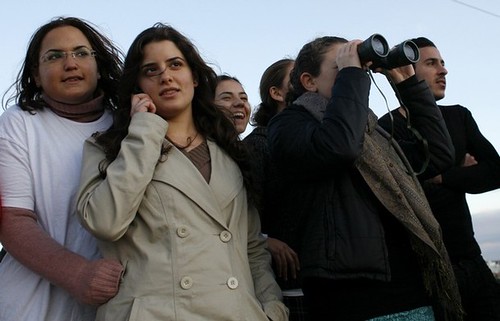
Magnes Zionist describes the dehumanization of the people of Gaza in Israeli consciousness. But "dehumanization" is a word with a double meaning. There is a people of Gaza who are treated as if they were not human. And there are the people in these pictures above, who have dehumanized themselves by giving up the elemental human ability of telling the difference between right and wrong.
Israel's free media?
Here's an interesting spat between an Arab member of the Israeli parliament (Knesset), Jamal Zahalka and veteran Israeli reporter, Dan Margalit. It's unpleasant viewing but the MK manages to expose the racism and bias of the Israeli media and the history of the zionist project in a short space of time:
And here is how the Jerusalem Post covered the interview.
And here is how the Jerusalem Post covered the interview.
On Thursday, Zahalka was removed from the set of the program after he and Margalit engaged in heated verbal sparring after Zahalka accused Defense Minister EhudI can see why Margalit would be angry. I mean fancy drawing attention to Barak's penchant for classical music when he's so heroic in Gaza.Barak of listening to classical music while children were being killed in Gaza.

January 03, 2010
Israel destroying a way of life
When millions of people have been displaced and thousands killed drilling down to the impact on families doesn't always take priority but here's a BBC website focus on how the occupation and annexation of the West Bank to the zionist entity is impacting on one family south of Hebron:
A flock of sheep and some scrawny goats huddle in a rough stone enclosure on a barren hillside south of Hebron.Oh, that's alright then but,They belong to Mohammed Abu Ali and his wife Fatima, and their family.
They live in a cave next to the sheep pen.
Fatima says the animals are all they have.
"They give us a rough time but they are good when we are desperate for money," she said. "They have to be well looked after, they have to be vaccinated - but at the end of the day, they support our life."
Mohammed says his ancestors have herded here for centuries.
But now times are hard. There's been a drought for several years.
If it rains, the rocky hillsides will be green. But now it is dry and bare with very little for the animals to eat.
Mohammed and his family live in an area of the West Bank that is under total Israeli control.
He says it is almost impossible to get permission to build new wells.
"Everything is forbidden, especially anything involving concrete," he said.
"To build a new well is not allowed. There are wells here but they are small and the water is not enough."
In a statement to the BBC, the Israeli civil administration said it was not aware of requests to build wells in the area - but it was ready to consider people's problems.
In the past shepherds would have wandered around to find greener pastures.Meanwhile, in Gaza...But now they say they face harassment from Jewish settlers when they move with their animals.
And their traditional grazing grounds are used by the Israeli army for military training.
The army says most of the land does not belong to the shepherds. In a statement, it said the restrictions on movement were for the safety and security of civilians.
The United Nations says a whole way of life is under threat.
Hamid Qawasmeh, from the UN Office for the Co-ordination of Humanitarian Affairs, said the future for these herding communities looked grim.
"People can't access the land, they can't herd as they did in the past," he said. "We have less and less rainwater every year, so with all these problems combined we are not seeing a very bright future for these populations."
Back at Mohammed Abu Ali's cave, tea was being prepared.
On a pile of blankets in the corner, his baby grandson, Jihad, lay cradled in his mother's arms.
It isn't clear if he will grow up to be a shepherd like his ancestors or if this ancient way of life is slowly coming to an end.
January 02, 2010
Atzmon is claiming to be Saladin now
Gaza is the priority for anti-zionists right now but, mindful of this, there are many racist freeloaders who want to gate crash the cause to hitch their own obsessions on to it.
I'm not changing the subject when I say that I gather Atzmon is upset at the exposé of his ludicrous hoax about whistle blowers in the UK's Jewish establishment. While Gaza is starving Atzmon knows what is best for the Palestinian cause: make up another id, write another ludicrous article in the name of that id and get it distributed to as many anonymously produced conspiracy sites as he can.
Atzmon relies heavily on people not checking what he is writing so please do check the assertions made in his latest offering using the name, Salaheddin Ahmad by reading my post (linked above) and Tony Greenstein's and seeing if anything he accuses us both of in that article alone is true. Google the name he has invented as it appears with the Redress article and see if this latter day Saladin has had anything else published on the web or indeed anywhere. Or google the name on its own, scroll down and consider, could it really be the US attorney or the only Salaheddin Ahmad to appear in the US telephone directory? Of course it couldn't. It's Atzmon...again and not because of the impeccable English (which neither Tony nor I could be the judges of) but because of the sheer dishonesty, the racism and the buffoonery.
The UK's Socialist Workers Party has quietly dropped Atzmon as was predicted, there are many Palestinian groups and individuals in the UK that won't touch Atzmon with a barge pole and even Mary Rizzo had to ditch him and the last post he made to the Palestine Think Tank when his racism and his dishonesty had complaints against him outnumbering the trolls she used to rely on to defend him. So there he is, painted into a corner and all he can do now is make up more names, write more silly articles for Redress and other silly and/or nasty conspiracy sites and hope that the Community Security Trust and the Jewish Chronicle are desperate enough to pretend to take Redress seriously or stupid enough to really take it seriously.
I'm not changing the subject when I say that I gather Atzmon is upset at the exposé of his ludicrous hoax about whistle blowers in the UK's Jewish establishment. While Gaza is starving Atzmon knows what is best for the Palestinian cause: make up another id, write another ludicrous article in the name of that id and get it distributed to as many anonymously produced conspiracy sites as he can.
Atzmon relies heavily on people not checking what he is writing so please do check the assertions made in his latest offering using the name, Salaheddin Ahmad by reading my post (linked above) and Tony Greenstein's and seeing if anything he accuses us both of in that article alone is true. Google the name he has invented as it appears with the Redress article and see if this latter day Saladin has had anything else published on the web or indeed anywhere. Or google the name on its own, scroll down and consider, could it really be the US attorney or the only Salaheddin Ahmad to appear in the US telephone directory? Of course it couldn't. It's Atzmon...again and not because of the impeccable English (which neither Tony nor I could be the judges of) but because of the sheer dishonesty, the racism and the buffoonery.
The UK's Socialist Workers Party has quietly dropped Atzmon as was predicted, there are many Palestinian groups and individuals in the UK that won't touch Atzmon with a barge pole and even Mary Rizzo had to ditch him and the last post he made to the Palestine Think Tank when his racism and his dishonesty had complaints against him outnumbering the trolls she used to rely on to defend him. So there he is, painted into a corner and all he can do now is make up more names, write more silly articles for Redress and other silly and/or nasty conspiracy sites and hope that the Community Security Trust and the Jewish Chronicle are desperate enough to pretend to take Redress seriously or stupid enough to really take it seriously.

Subscribe to:
Posts (Atom)